
Palm Sunday


When we think of Palm Sunday, most of us think of palms being waved in church one Sunday every year. Others may associate it directly with Easter, signaling the need to prepare the home for an Easter feast with family and friends. Still others may not have anything to relate it to besides chocolate bunnies and colored eggs if they have no religious training.
Let's take a few moments to consider the original story of Jesus' triumphant entry into Jerusalem that notable day more than 2000 years ago. To really grasp the significance of Palm Sunday, it's important to travel back in time to understand what it was like in Jerusalem.
Something was stirring. Passover was just days away, and preparations were already underway. There was a heightened expectation in the hearts of the people as they remembered the original exodus from Egypt that generations before them had experienced. It was nothing less than miraculous. YHWH moved in unprecedented ways to break their chains of bondage and set His people free. Certainly, it was something to remember. Something to celebrate.
So, let's begin in Matthew 21:4-5:
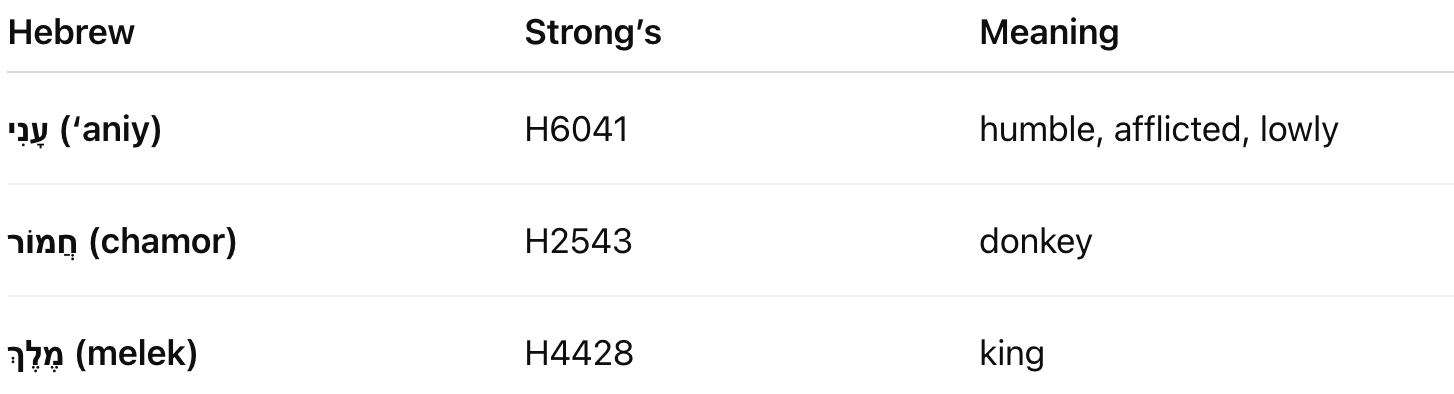
Key Hebrew terms:
Septuagint (LXX)
- πραΰς (praus) = reinforces gentle/humble king, not weak—but restrained authority.
👉 Important: The Hebrew poetic parallelism (“donkey / colt”) is one animal described two ways, but Matthew highlights both—intensifying fulfillment.
Royal Animal Symbolism
In the Ancient Near East (ANE), what you rode communicated your mission.
→ Solomon [son of King David] rode his father's mule at his own coronation. He did not ride a warhorse.
👉 This is crucial: kings rode donkeys in times of peace.
Processional Imagery
ANE kings often staged symbolic entries into cities:
- Victory parades (on horses/chariots)
- Peaceful enthronement processions (on donkeys)
On this particular day, Jesus intentionally chose the second category.
Crowd Behavior (Palm Branches)
Palm branches were the nationalistic victory symbol...
- Seen on Hasmonean coins
- Used during Sukkot
- Associated with liberation and kingship
Crowd cries:
- fὡσαννά (Hosanna) ← Hebrew הוֹשִׁיעָה נָּא (hoshi‘ah na)
→ “Save now!” (see Psalm 118)
👉 This is not a quiet religious moment—it’s politically explosive.
Complete Text
📖 Complete Palm Sunday text in all four gospels: Matthew 21:1-11; Mark 11:1-10; Luke 19:28-40; and John 12;12-19, can be found at the end.Subversive Kingship
👉 Jesus is claiming to be king—but in a way that quietly overturns every expectation of what a king is.
So, what is Jesus actually doing?
Key Greek Word
πραΰς (praus, G4239)
= gentle, humble, controlled strength (not weakness)
Hebrew Background: Zechariah 9:9
עָנִי (‘aniy, H6041)
= lowly, afflicted, humble—but often of someone dependent on God, not powerless
👉 So textually:
Jesus is openly fulfilling a royal prophecy—He is claiming kingship.
There is also a cultural layer to Zechariah 9:9, which is why His Kingship is considered subversive.
In the Ancient Near East (and Roman world), kings signaled their intent by how they entered a city:

It's important to understand the Roman expectations in Jesus’ day:
- Roman generals entered cities in a Triumph
- Riding war horses or chariots
- Surrounded by soldiers, captives, and spoils of war.
👉 This is what people expected from a “king” or “messiah.”
What Jesus Does Instead:
- No army, weapons, war horses, or conquest.
👉 He rides a donkey
To the Romans, His entrance says:
👑 “I am king—but not the kind you think.”
So, what does this mean theologically?
Subversive kingship = simple answer
👉 A real claim to authority that undermines and redefines power itself.
Jesus literally flipped the script when He entered Jerusalem as King:
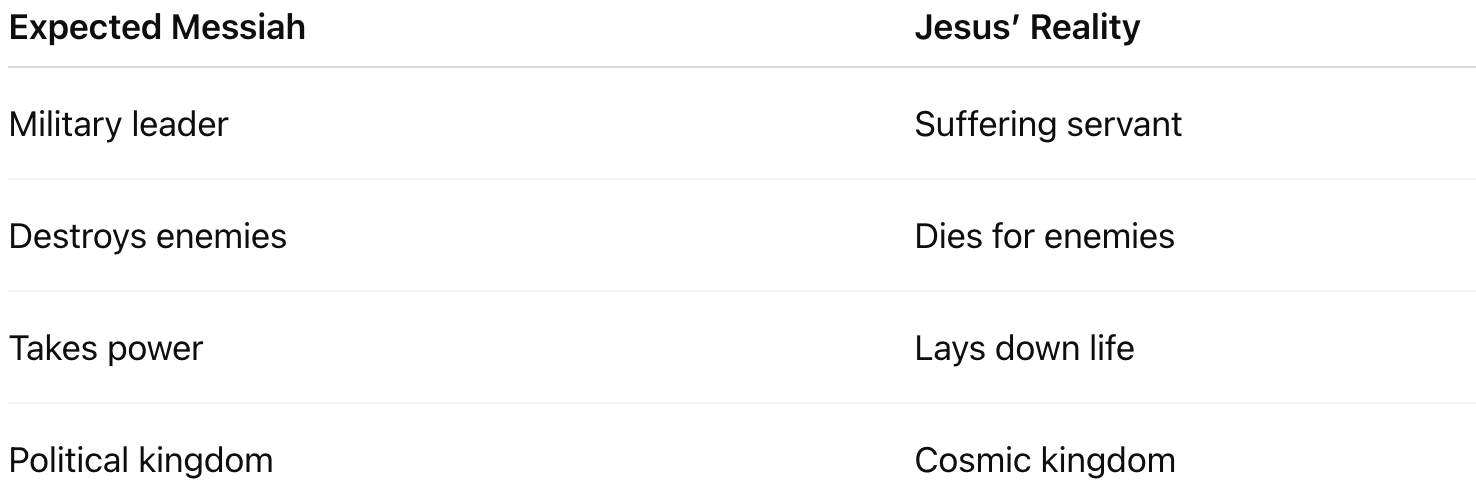
His entrance as King challenged Rome (without a battle). It also challenged Jewish expectations. He redefined power as humility.
👉 It’s not less authority—it’s authority expressed differently.
By riding the donkey and accepting Psalm 118 praise, Jesus is saying:
- “I am the promised king”
- “I am the one who brings salvation”
BUT HE ALSO IS SAYING:
- “You don’t understand what kind of salvation I bring!”
From an ANE perspective, this is shocking because:
- A king should display power visibly, but Jesus displayed restrained power
👉 This is why people later reject Him: He doesn’t perform the expected script of domination or kingship.
This is not passive humility—it’s strategic signaling.
Jesus is:
- Publicly fulfilling prophecy
- Forcing a decision:
- Accept Him as king on His terms
- Or reject Him
👉 There is no neutral ground then, the same as it is today.
Jesus' Subversive Kingship means:
- Jesus is truly king
- But He redefines:
- power → humility
- victory → sacrifice
- rule → service
👉 He doesn’t reject kingship.
👉 He redefines it from the ground up.
Jesus is acting out Zechariah 9:9–10, but people miss verse 11, the next verse; let's look at the passage:
“He will cut off the chariot… the war horse… and speak peace to the nations.”
👉 He didn't arrive as a conquering Davidic warrior, but as a peace-bringing king.
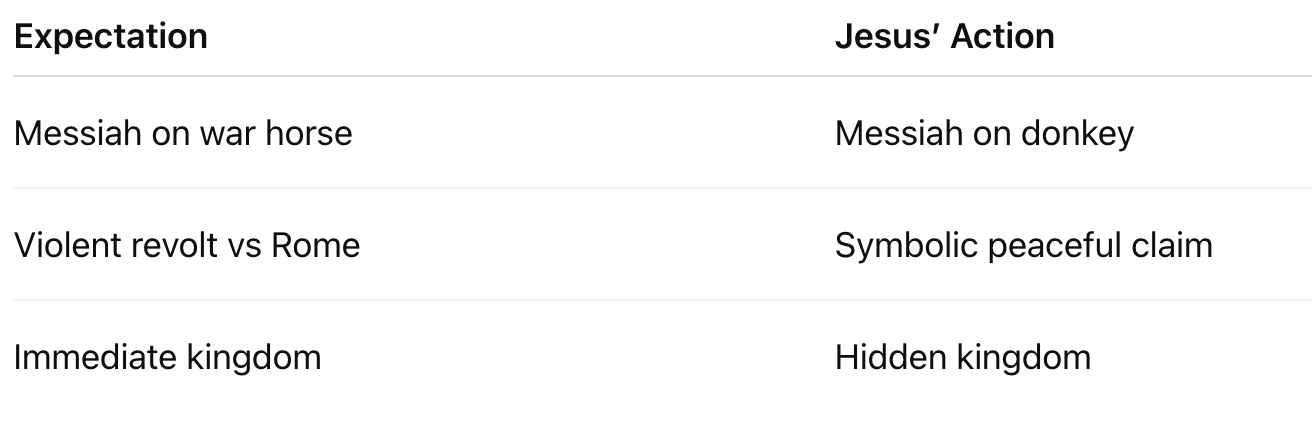
Palm Sunday is a living parable ... prophetic theater.
Why a donkey?
- It looks weak to us, but in ANE context, it screams:
- “I am king”
- “I come in peace”
- “I am legitimate heir”
👉 This is a royal claim without military aggression.
This moment sets up tension:
- Crowd expectation: political overthrow
- Jesus’ mission: cosmic redemption
👉 Within days, because He didn't match their ANE messianic war template,
- The same crowd shouting “Hosanna” will cry “Crucify”
The Qumran scrolls indicate that many of them expected two Messiahs:
- Priest (spiritual)
- King (military)
Jesus fuses categories—but in a way that confuses everyone.
SUMMARY
- Textually: Jesus fulfills Zechariah precisely (humble king on donkey)
- Culturally (ANE):
- Donkey = peace, legitimacy, kingship
- Horse = war, conquest
- Theologically:
- Jesus declares kingship
- But redefines what kind of king He is
👉 This is not a humble accident—it is a calculated royal announcement in ANE language.
_______
© 2026 Jan Ross
All Rights Reserved
“Sit often under the influence of God’s Word.”🌻
www.janross.org/devotions/
Enjoy this deep dive?
Forward to a friend and let them know where they can subscribe (hint: it’s here).
Want to share what God is doing in your life? Submit a short story to include in a future devotion.
Anything else? Send me an email at [email protected]!
👉 Want to create your own blog or website? Or know someone who's thinking about it? Use my referral link to get started! (Note: I earn a small commission at no additional cost to you if you use the referral link. Thank you for your support!)
Palm Sunday Scriptures
Matthew 21:1–11
1 Now when they drew near to Jerusalem and came to Bethphage, to the Mount of Olives, then Jesus sent two disciples, 2 saying to them, “Go into the village in front of you, and immediately you will find a donkey tied, and a colt with her. Untie them and bring them to me. 3 If anyone says anything to you, you shall say, ‘The Lord needs them,’ and he will send them at once.” 4 This took place to fulfill what was spoken by the prophet, saying, 5 “Say to the daughter of Zion, ‘Behold, your king is coming to you, humble, and mounted on a donkey, on a colt, the foal of a beast of burden.’ ” 6 The disciples went and did as Jesus had directed them. 7 They brought the donkey and the colt and put on them their cloaks, and he sat on them. 8 Most of the crowd spread their cloaks on the road, and others cut branches from the trees and spread them on the road. 9 And the crowds that went before him and that followed him were shouting, “Hosanna to the Son of David! Blessed is he who comes in the name of the Lord! Hosanna in the highest!” 10 And when he entered Jerusalem, the whole city was stirred up, saying, “Who is this?” 11 And the crowds said, “This is the prophet Jesus, from Nazareth of Galilee.”
Mark 11:1–10
1 Now when they drew near to Jerusalem, to Bethphage and Bethany, at the Mount of Olives, Jesus sent two of his disciples 2 and said to them, “Go into the village in front of you, and immediately as you enter it you will find a colt tied, on which no one has ever sat. Untie it and bring it. 3 If anyone says to you, ‘Why are you doing this?’ say, ‘The Lord has need of it and will send it back here immediately.’ ” 4 And they went away and found a colt tied at a door outside in the street, and they untied it. 5 And some of those standing there said to them, “What are you doing, untying the colt?” 6 And they told them what Jesus had said, and they let them go. 7 And they brought the colt to Jesus and threw their cloaks on it, and he sat on it. 8 And many spread their cloaks on the road, and others spread leafy branches that they had cut from the fields. 9 And those who went before and those who followed were shouting, “Hosanna! Blessed is he who comes in the name of the Lord! 10 Blessed is the coming kingdom of our father David! Hosanna in the highest!”
Luke 19:28–40
28 And when he had said these things, he went on ahead, going up to Jerusalem. 29 When he drew near to Bethphage and Bethany, at the mount that is called Olivet, he sent two of the disciples, 30 saying, “Go into the village in front of you, where on entering you will find a colt tied, on which no one has ever yet sat. Untie it and bring it here. 31 If anyone asks you, ‘Why are you untying it?’ you shall say this: ‘The Lord has need of it.’ ” 32 So those who were sent went away and found it just as he had told them. 33 And as they were untying the colt, its owners said to them, “Why are you untying the colt?” 34 And they said, “The Lord has need of it.” 35 And they brought it to Jesus, and throwing their cloaks on the colt, they set Jesus on it. 36 And as he rode along, they spread their cloaks on the road. 37 As he was drawing near—already on the way down the Mount of Olives—the whole multitude of his disciples began to rejoice and praise God with a loud voice for all the mighty works that they had seen, 38 saying, “Blessed is the King who comes in the name of the Lord! Peace in heaven and glory in the highest!” 39 And some of the Pharisees in the crowd said to him, “Teacher, rebuke your disciples.” 40 He answered, “I tell you, if these were silent, the very stones would cry out.”
John 12:12–19
12 The next day the large crowd that had come to the feast heard that Jesus was coming to Jerusalem. 13 So they took branches of palm trees and went out to meet him, crying out, “Hosanna! Blessed is he who comes in the name of the Lord, even the King of Israel!” 14 And Jesus found a young donkey and sat on it, just as it is written, 15 “Fear not, daughter of Zion; behold, your king is coming, sitting on a donkey’s colt!” 16 His disciples did not understand these things at first, but when Jesus was glorified, then they remembered that these things had been written about him and had been done to him. 17 The crowd that had been with him when he called Lazarus out of the tomb and raised him from the dead continued to bear witness. 18 The reason why the crowd went to meet him was that they heard he had done this sign. 19 So the Pharisees said to one another, “You see that you are gaining nothing. Look, the world has gone after him.”
No spam, no sharing to third party. Only you and me.


Member discussion